
UAE E-Invoicing Readiness Begins With Better Records

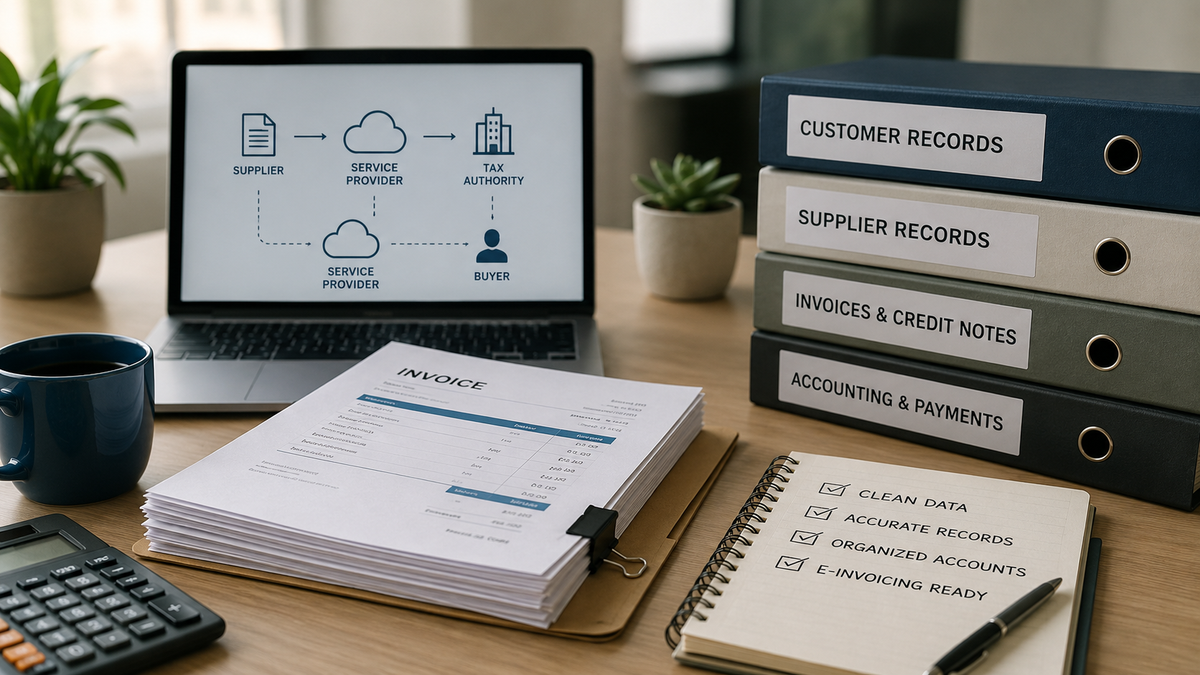
UAE e-invoicing is not only a technology change. For small businesses, it is also a record-keeping change.
The UAE Ministry of Finance’s Electronic Invoicing Guidelines explain that e-invoicing will apply to persons conducting business in the UAE unless specifically excluded. The system uses structured electronic invoices and credit notes, not only ordinary PDF invoices or scanned copies. It also links the supplier, the supplier’s Accredited Service Provider, the buyer’s Accredited Service Provider, the buyer, and the Federal Tax Authority through a five-corner model.
For many SMEs, the practical lesson is simple: clean data will matter as much as the invoice itself. If customer details, tax information, product descriptions, payment records, or accounting entries are messy today, e-invoicing can make those gaps more visible later.
Start with invoice basics
A good first step is to review how invoices are created now. Many small businesses still prepare invoices manually, reuse old templates, or keep different versions across email, spreadsheets, accounting software, and WhatsApp conversations. That may work when volume is low, but it can create problems when invoices need to follow a structured format.
Businesses can begin by checking whether each invoice has consistent customer names, trade names, addresses, TRNs where applicable, invoice numbers, dates, item descriptions, amounts, VAT treatment, discounts, credit notes, and payment status.
The goal is not to make the invoice look more professional only. The goal is to make the invoice data easier to read, match, report, and audit.
Clean customer and supplier data early
E-invoicing depends on accurate business information. The Ministry of Finance guidelines note that taxpayers registered with the FTA already have a Tax Identification Number, which is the first 10 digits of the TRN, while persons in scope but not registered for tax may need to register with the FTA to obtain a TIN.
This makes customer and supplier records more important. SMEs can review their contact lists and separate personal names from company names, update trade license details, confirm billing addresses, and record TRNs where relevant.
One common mistake is treating customer data as only a sales record. Under a more digital invoicing process, customer data also becomes part of accounting, tax, payment follow-up, and compliance workflows. A spelling error, missing TRN, outdated address, or duplicate customer profile can create unnecessary correction work.
Data privacy also matters. Businesses should only collect the information needed for invoicing and accounting, store it securely, and avoid sharing customer data through informal channels when safer systems are available.
Accounting records need to match reality
E-invoicing preparation is easier when accounting records are already organised. Sales invoices, receipts, credit notes, bank deposits, refunds, and supplier bills should connect clearly to each other.
Small businesses can review whether their accounting software can export useful reports, whether invoice numbers are sequential, whether credit notes are properly linked to original invoices, and whether bank transactions are reconciled regularly.
The Ministry of Finance readiness steps include understanding e-invoicing requirements, identifying accounting or ERP system changes, selecting an Accredited Service Provider, testing invoice exchange and reporting, and going live according to the phased plan.
The current phased plan in the guidelines says persons with annual revenue below AED 50 million have a later mandatory timeline than larger businesses, with the last date to appoint an ASP listed as 31 March 2027 and implementation listed as 1 July 2027. Larger businesses have earlier dates.
That gives smaller businesses time, but waiting too long can make preparation harder. Cleaning records takes longer when invoices, customer data, and accounting files have been inconsistent for years.
Mistakes SMEs should avoid
One mistake is assuming e-invoicing is only a software subscription. Software may help, but poor data will still create problems.
Another mistake is keeping invoice records in too many places. When the sales team, accountant, owner, and customer all have different invoice copies, it becomes harder to know which record is final.
A third mistake is ignoring supplier invoices. Businesses will not only issue invoices. They may also receive electronic invoices from suppliers, so purchase records, approval workflows, and payment tracking should be reviewed too.
A safer habit is to create one clean invoicing process now: one invoice source, one customer record, one numbering method, one credit note process, and one regular accounting review. That can reduce confusion before e-invoicing becomes part of daily business operations.
The real preparation is not panic or rushing into tools. It is building reliable records so the business can move into e-invoicing with fewer corrections, fewer disputes, and clearer financial visibility.
Key Takeaways
• UAE e-invoicing preparation starts with clean invoice data, accurate customer records, and organised accounting files.
• Small businesses should review customer details, TRNs where applicable, invoice numbering, credit notes, and supplier records before deadlines arrive.
• Software alone will not solve messy records. A clear invoicing process and regular accounting review can make the transition safer and easier.
Sources: UAE Ministry of Finance Electronic Invoicing Guidelines, The Official Portal of the UAE Government.
Disclaimer: This article is for educational and informational purposes only. It is not legal, financial, investment, cybersecurity, business, career, tax, medical, or professional advice. Investing content is general education only and is not a recommendation to buy, sell, hold, trade, or use any asset, product, platform, broker, or service. Readers should verify important information through official sources or qualified professionals before making decisions.


