How to Check if an Investment Platform Is Properly Regulated

A professional website, a mobile app, and a confident sales message do not prove that an investment platform is properly regulated. Many risky platforms use official-sounding language, licence numbers, office addresses, or “global regulation” claims to appear safer than they really are.
For readers, the useful habit is simple: do not only ask whether a platform is “licensed.” Ask licensed by whom, for what activity, in which jurisdiction, and under what name.
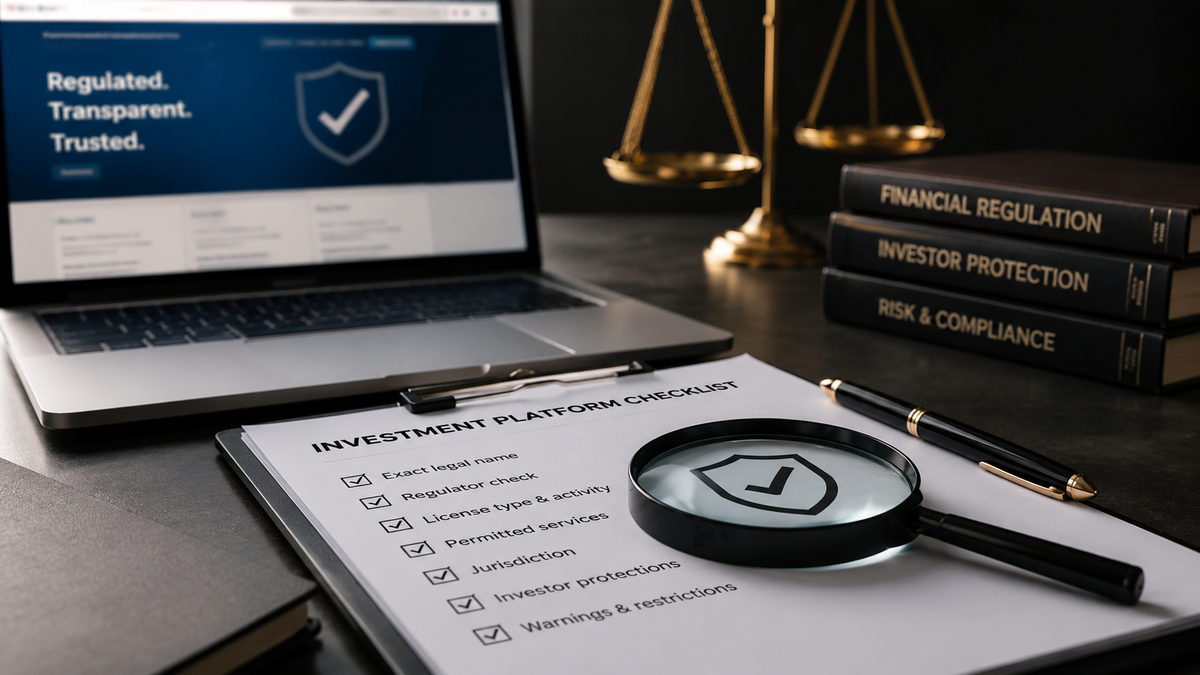
Start with the exact legal name
The first step is to find the platform’s full legal name. This may be different from the app name, brand name, or website name. A platform may promote itself using a short trading name, while the actual licensed entity has a longer company name.
Check the footer, terms of service, privacy policy, risk disclosure, app store listing, and account-opening documents. Then compare that name with the regulator’s public register. Small spelling changes, different company locations, or unrelated group companies are warning signs.
In the UAE, the Securities and Commodities Authority lists entities licensed or authorised to conduct specific financial activities and services. This matters because a firm may be licensed for one activity but not for another. SCA’s own notice explains that a Category 5 licence may allow limited introducing or advisory activity, but does not automatically authorise trading operations, portfolio management, or order execution.
Match the licence to the service
A licence is not a blank cheque. A company regulated for payments is not automatically regulated for securities trading. A company licensed for advisory services may not be allowed to hold client money. A crypto firm with early approval may not yet be allowed to serve customers.
For banking, finance, exchange business, stored value facilities, retail payment services, loan-based crowdfunding, and related regulated financial activities, the Central Bank of the UAE says firms and individuals must apply for authorisation before carrying out activities it regulates.
For firms operating in the Dubai International Financial Centre, the Dubai Financial Services Authority has a public register covering firms, individuals, funds, and related categories. For Abu Dhabi Global Market, the FSRA Public Register is described as the official public record showing firms, individuals, funds, and other bodies approved by the FSRA.
Virtual asset platforms need extra care. VARA says any firm carrying out virtual asset activities in or from Dubai, excluding DIFC, has a legal obligation to be licensed before operating.VARA’s public register also separates fully licensed virtual asset service providers from firms holding in-principle approval, and states that in-principle approval holders are not allowed to start operations or service clients until they receive a full VASP licence.
Do not rely on screenshots or sales claims
A screenshot of a licence, a badge on a homepage, or a salesperson’s message is not enough. These can be outdated, incomplete, copied, or misleading. The safer method is to visit the regulator’s official register directly and search the firm name yourself.
Also check whether the regulator lists any restrictions, withdrawn permissions, warnings, enforcement action, or limits on client type. Some platforms may be approved only for professional, institutional, or qualified investors, not ordinary retail users.
Another common mistake is confusing a normal business licence with financial regulation. A company may be legally incorporated or have a trade licence, but that does not mean it is authorised to provide investment, brokerage, custody, crypto, fund, or advisory services.
Warning signs to slow down
Be careful when a platform avoids naming its regulator, refuses to give its legal entity name, pressures users to deposit quickly, promises high or fixed returns, uses private messaging apps for onboarding, or asks users to send money to personal accounts.
Other warning signs include vague “international licence” claims, no clear complaint process, no proper risk disclosure, offshore entities with no local authorisation, or a licence that belongs to a different company.
Regulation does not remove investment risk. A regulated firm can still offer risky products, charge fees, or expose users to market losses. But checking regulation helps users separate authorised firms from platforms that may be operating outside proper oversight.
Before using any investment platform, take a few minutes to check the official register, match the exact legal name, confirm the permitted activity, and understand which regulator is responsible. That small habit can prevent confusion before money is sent.
Key Takeaways
• A platform’s brand name is not enough. Check the exact legal entity name on the official regulator register.
• A licence must match the service being offered, such as brokerage, advisory, payments, custody, crypto exchange, or portfolio management.
• Regulation reduces some platform risk, but it does not make an investment safe, guaranteed, or suitable for everyone.
Sources: Securities and Commodities Authority, Central Bank of the UAE, Dubai Financial Services Authority, ADGM Financial Services Regulatory Authority, Virtual Assets Regulatory Authority.
Disclaimer: This content is for educational and informational purposes only. It is not legal, financial, investment, cybersecurity, medical, business, career, or other professional advice. Verify important information with official sources or qualified professionals before acting.


