
Build a 90-Day Skills Plan You Can Keep Using

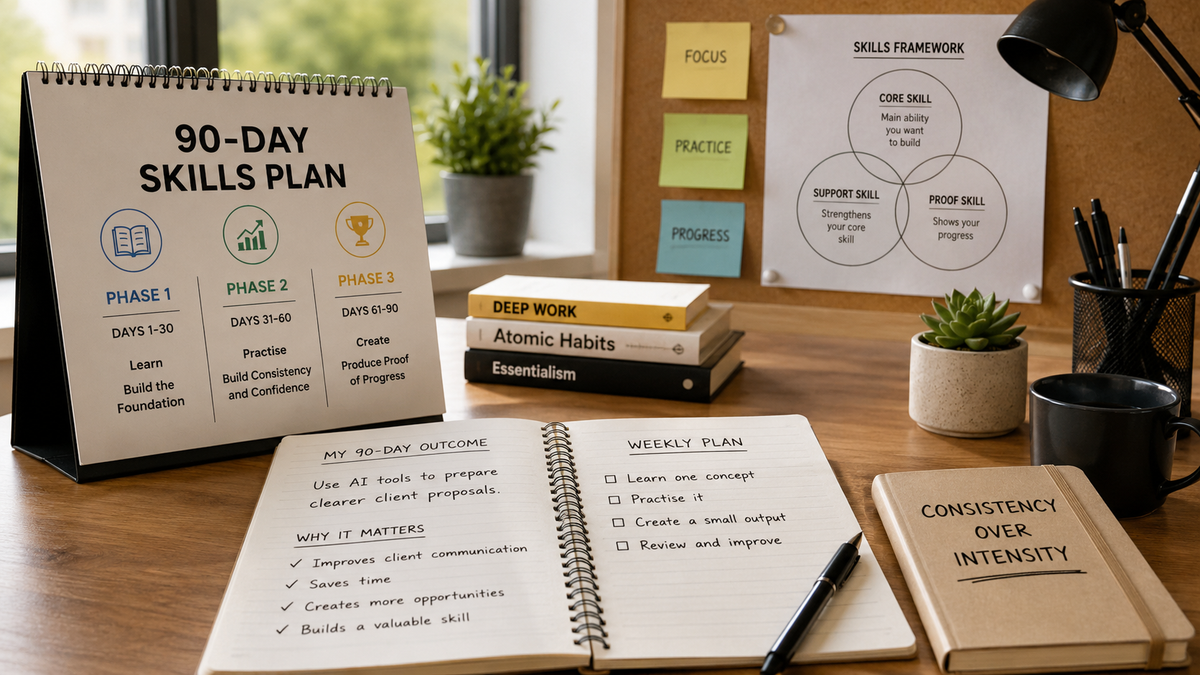
Most people do not fail at learning because they are lazy. They fail because their plan is too wide, too vague, or too far from real work.
A useful skills plan does not start with 20 courses. It starts with one honest question: what skill would make your work, income awareness, business, or career direction stronger in the next three months?
This is useful context because the skills conversation is no longer only about degrees or job titles. The World Economic Forum’s Future of Jobs Report 2025 says employers expect 39% of workers’ core skills to change by 2030. The OECD also describes skills-first approaches as a way to give more attention to what people can actually do, not only the credentials they hold.
A 90-day plan works because it is long enough to build progress, but short enough to stay realistic. The goal is not to become an expert in everything. The goal is to choose one useful direction, practise consistently, and finish with proof that you improved.
Start with one clear outcome
Before choosing a course, write one clear outcome.
Not “learn AI.”
Better: “Use AI tools to prepare clearer client proposals.”
Not “improve communication.”
Better: “Write clearer emails, updates, and reports at work.”
Not “learn investing.”
Better: “Understand basic investing terms, risk, fees, and scams before making decisions.”
A useful 90-day outcome should pass three tests.
First, it should connect to your real life. It should help with your job, business, income awareness, safety, or future options.
Second, it should be visible. You should be able to show progress through a sample, document, project, checklist, presentation, portfolio item, or improved workflow.
Third, it should be small enough to practise every week. If the outcome needs expensive tools, full-time study, or perfect conditions, it is probably too large for 90 days.
Use the 3-lane skills framework
A strong skills plan usually needs three lanes: core skill, support skill, and proof skill.
The core skill is the main ability you want to build. This could be data analysis, business writing, AI-assisted research, customer communication, basic financial literacy, cybersecurity awareness, or project management.
The support skill helps you use the core skill better. For data analysis, the support skill may be spreadsheet organisation. For business writing, it may be research. For AI-assisted work, it may be fact-checking and privacy awareness.
The proof skill is how you show progress. This could be a portfolio sample, a before-and-after document, a simple dashboard, a checklist, a mock client proposal, a short presentation, or a written reflection.
This keeps the plan practical. Many people collect knowledge but never produce evidence. A proof skill forces you to turn learning into something usable.
For example, someone who wants to improve AI skills for work might choose:
Core skill: using AI to draft and organise work documents.
Support skill: checking facts, protecting private information, and improving prompts.
Proof skill: building three polished templates for emails, reports, and meeting summaries.
That is much clearer than “take an AI course.”
Split the 90 days into three phases
The first 30 days are for direction. The aim is to understand the basics, choose your tools, and build a routine. Do not overload this phase. Pick one course, one book, one trusted channel, or one structured learning path. Add notes, but keep them short.
By the end of day 30, you should have a simple map of the skill. What are the main terms? What mistakes do beginners make? What tools or methods are commonly used? What does good work look like?
Days 31 to 60 are for practice. This is where the plan becomes real. Choose one small weekly project. If you are learning business writing, rewrite one old email or article section every week. If you are learning spreadsheets, clean and organise one sample dataset. If you are learning digital safety, create a personal account security checklist and apply it to your main accounts.
This phase should feel slightly uncomfortable. Reading is easier than doing. Real progress comes from practice, correction, and repetition.
Days 61 to 90 are for output. Your task is to create proof of progress. This does not need to be public. It can be a private portfolio, internal work sample, saved template, checklist, or personal system.
The final output should answer one question: what can I do now that I could not do clearly 90 days ago?
LinkedIn’s 2025 Workplace Learning Report says career progress is people’s top motivation to learn. That is a useful reminder: learning is easier to continue when it connects to a future you can see.
Keep the weekly routine simple
A simple weekly rhythm is better than a perfect plan you abandon.
Use this structure:
Monday: choose the week’s focus.
Tuesday or Wednesday: learn one concept.
Thursday: practise it.
Friday or Saturday: create or improve one small output.
Sunday: review what worked, what failed, and what to adjust.
You do not need long sessions. Three to four focused sessions of 30 to 45 minutes per week can be enough for visible progress if the work is consistent.
Keep a small skills log with four columns:
Date
What I practised
What I produced
What I need to improve next
This log is important because it prevents fake progress. Watching videos can feel productive, but producing something shows whether the skill is becoming useful.
Imagine a freelancer who wants to improve client communication.
Their outcome could be: “Write clearer proposals and project updates so clients understand scope, timelines, and next steps.”
Their core skill is business communication. Their support skill is project planning. Their proof skill is a set of reusable templates.
Days 1 to 30: study strong proposal structure, review old messages, and collect common client questions.
Days 31 to 60: rewrite one proposal, one update email, and one delivery note each week.
Days 61 to 90: create a small communication toolkit with a proposal template, project update template, revision policy note, and final delivery message.
By the end, the person has more than knowledge. They have a practical system they can reuse.
The main mistake to avoid is choosing too many skills. A 90-day plan should not become a personal university. One main skill is enough.
Another mistake is learning without a use case. “I want to learn coding” is too broad. “I want to build a simple landing page for my service” is easier to plan.
Do not depend only on motivation. Motivation changes. A weekly routine protects the plan when motivation drops.
Ask for feedback when possible. A trusted review, comparison with a good example, or simple self-check can save time and help you improve faster.
Also keep safety in mind. If your skill involves AI, finance, cybersecurity, health, law, or business decisions, verify important information through official or qualified sources. Do not copy sensitive data into tools without checking privacy risks. Do not treat online content as professional advice.
Your 90-day action plan:
Choose one outcome for the next 90 days.
Select one core skill, one support skill, and one proof skill.
Pick one main learning source.
Schedule three to four weekly practice sessions.
Create one small output every week.
Keep a simple skills log.
Review progress every 30 days.
Finish with one useful proof of progress.
The best skills plan is not the most ambitious one. It is the one you can repeat, apply, and show evidence for. In 90 days, the aim is not perfection. The aim is a stronger direction, better habits, and one skill that is more useful than it was when you started.
Key Takeaways
• A good 90-day skills plan starts with one practical outcome, not a long list of courses.
• The 3-lane framework keeps learning focused: core skill, support skill, and proof skill.
• Weekly practice and visible outputs matter more than passive learning.
Sources: World Economic Forum, OECD, LinkedIn Learning.
Disclaimer: This content is for educational and informational purposes only. It is not legal, financial, investment, cybersecurity, medical, business, career, or other professional advice. Verify important information with official sources or qualified professionals before acting.


